
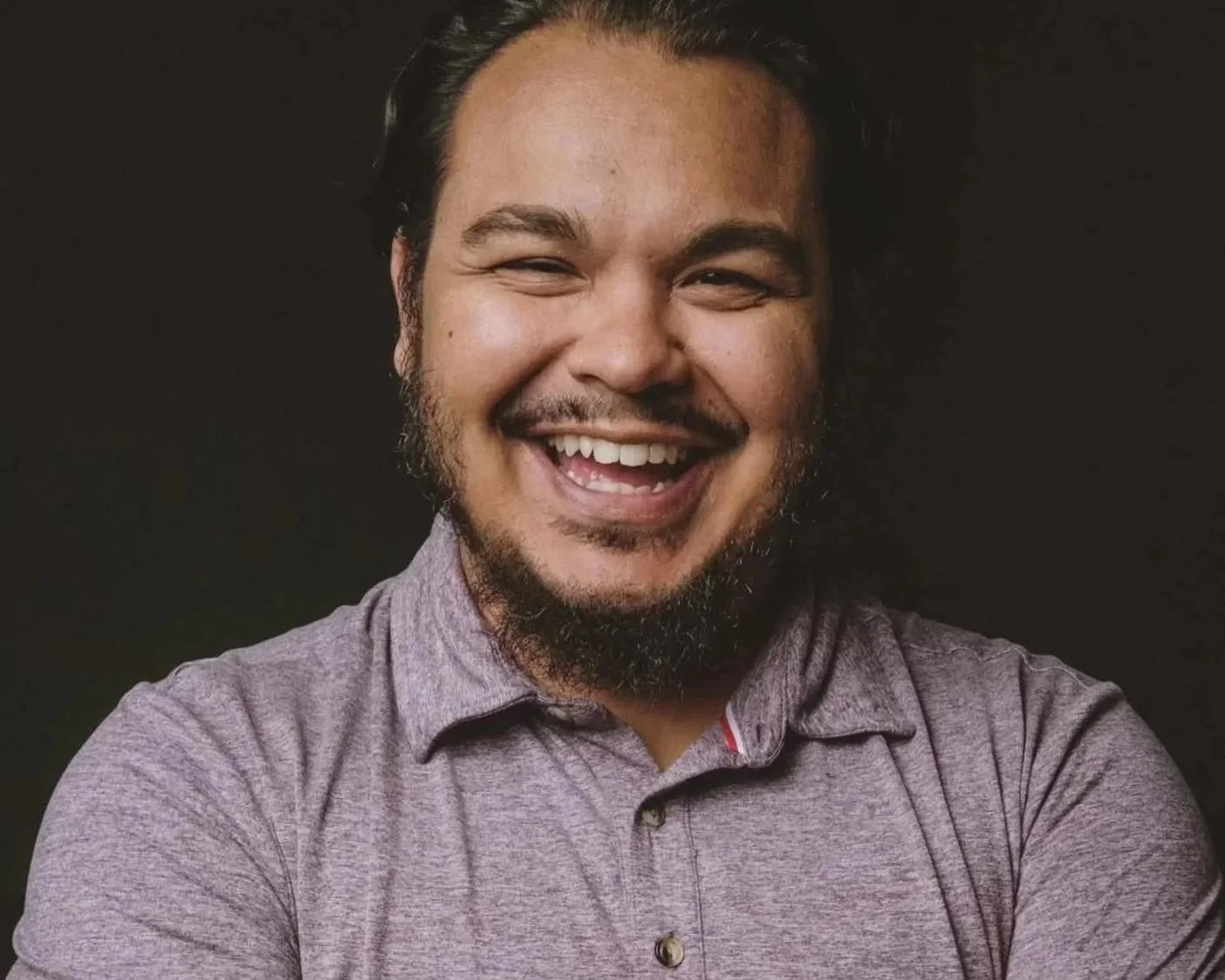
Arts In The Field: Sergio Salgado, Comedian
By Lydia Moran, PLRAC storyteller
When I ask Sergio Salgado how he got into comedy, he starts by telling me that growing up, he was the “ugly kid” out of his two siblings.
“I knew that I wasn’t the most favorable in terms of looks. It forced me to market myself in a different way," he said.
We are sitting in the staff lounge at Mankato State University's cafeteria while Sergio is on his lunch break from being an Admissions Counselor. To be fair, the "ugly kid" allegation doesn't hold up these days; Sergio is easy to don a wide grin and has a down-to-earth persona that makes him a good support person for college students.
But, growing up, he felt he had to work to stand out, and so he became the class clown.
In sixth grade, Sergio saw his first stand up special on TV, and realized what can happen when a class clown sharpens their natural abilities. For 20 minutes, George Lopez made an entire theater laugh with "nothing other than his words."
“I was like, I want that. I want to have that kind of control over an audience, that kind of power, because it ultimately brings them joy, and it brings you joy,” he said.
Sergio forged his talent for the stage in high school theater and college speech and debate. But stand-up drew him back and in 2018, he took the mic at the Coffee Hag's comedy night in downtown Mankato. Since then, Sergio has performed all over the state.
His process for writing jokes has evolved with him. He workshops his jokes in "focus groups" of friends, family, and co-workers to test how they play with different demographics. He often mines his life and childhood for material, and said some of his best moments on stage come from hard times and traumatic experiences. Through sharing, he hopes he helps others feel less alone.
"I never want to punch down. I always want to uplift people and say, 'Hey this happened to me, if happens to you, here's a funny way to deal with it.'"
Late last fall, Sergio continued “spreading the good word of comedy.” With support from a Prairie Lakes Regional Arts Council grant, he held a series of free stand-up workshops at the Centenary Social Justice Theater in Mankato. They were designed to help people not only learn the art of comedy, but gain confidence in public speaking, practice conflict resolution, and build community.
The workshops were open to everyone—no comedy experience required. One student, a retiree who had recently moved to the area, came looking to connect with their new neighbors. They did just that, and more, by attending the sessions.
Performing stand-up comedy is vulnerable. When it's just you, a microphone, and an audience, five minutes on stage can feel like a very, very long time. Students practiced being heckled, interrupted, and standing on stage as a joke didn’t land. Experiencing that silence helped prepare them for when that happens on a real stage.
Overcoming discomfort is a useful skill to have in general, making stand-up an excellent training ground for battling social anxiety.
"I want them to take ownership of [their voice]," he said. "It's a hard skill. In an increasingly digital world, having face-to-face conversations is becoming a lost art."
Students also debated one another to get "comfortable with the art of disagreement." Skills learned defending silly ideas, such as the notion that coffee is bad, can be used when discussing more serious topics.
"When you can learn how to publicly speak and communicate your message, that leads to natural conflict resolution. You get to the crux of what an issue is and how to fix it," he explained.
Embracing comedy could lead to a more open-minded and supportive community, Sergio said. It is a powerful vehicle for expressing ideas that are hard to talk about otherwise. He has found that in Mankato, for example, "race is one of those things that people are scared to talk about unless it's through the lens of humor."
"It's really interesting that for the arts community that we have here, we're pretty closed minded in the sense of what we can and cannot do. And I don't know if that's just because people are afraid to step out of their comfort zone or because they don't want to rock the boat that is Mankato. Because at the end of the day, you can't do art unless it's funded and the people funding the arts usually have a certain point of view they don't want rocked, which completely flies in the face of art."
As for the comedy scene in south central Minnesota, Sergio hopes it continues to grow. Along with that, he wants to see more diversity and collaboration within the wider arts community.
"I would really love an ego death in the arts community," he added. "I say that because it's been really hard as a person of color artist to break in. I really had to earn it.” Sergio notes that more funding and opportunities tailored to artists of color would be a step in the right direction.
“But when the opportunity isn't there, you create opportunity. Which is what I'm doing right now."
Later this spring, Sergio will host a public showcase where his students will perform stand-up, exhibiting the skills they learned during his workshops. Until then, he is keeping busy with private gigs and continues to perform regularly at the Circle Inn on Sundays, where he uses comedy to tell a story and share a message.
“You have an opportunity to [use humor to] bring people together as opposed to divide.”
Comedy is always important, he added, but now more than ever. It helps us make sense of the world and connect with others at a time when it matters most.
"I've always said that those three to five seconds that you're laughing, you're not worried about your bills, you're not worried about life, you're not worried about society kicking you down, the stock market—you're really in the moment," he said.
"There's no better moment than laughter and sharing that with another person, you're connected through that.”
Individual artist grants are made possible from funds provided by the McKnight Foundation. Learn more here.